 By Matt
• Live Performance Gear
• Published 17 Aug 2025 • Updated 17 July 2026
By Matt
• Live Performance Gear
• Published 17 Aug 2025 • Updated 17 July 2026
Excellent Wireless Guitar System Choices At All Budgets
Before you start reading, just letting you know that my site contains affiliate links, at no extra cost to you, but they may give me a small commission to help run the site. Feel free to get extra info on my disclaimers page. Thanks and on with the show...
I once went in a battle of the bands competition put on by the local youth centre. I think I was probably 14 or 15. Nerves in the stomach, we got up and played our roughly put together punk song and thought we did pretty well when we got off the stage.
Then the next band got up and the first thing I noticed was that they did not have any leads. They had these little pack things where the lead was supposed to go. Not only were they more polished and had a better song, they also had a better stage presence.
Not limited by the 10ft of cord, they moved around the stage just like a professional group. Even at that point I had not seen wireless systems at gigs I actually paid for.
I had not thought of that story for a long time, but it popped into my head the other night when I was watching a band at a local bar who were using a wireless system. So I thought, maybe I should write a post about them and look at what is available these days.
A good wireless system keeps your sound clean but also gives you the freedom to move around the stage. Not to mention, it saves you from packing up as many cables every night.
Continue reading to look at the background of these devices and to get a comparison of a few of the best models around these days.
A Quick History & How Wireless Guitar Systems Work
Wireless guitar systems have been around since the late 70s. Early versions were being used by bands like KISS and Van Halen, which makes sense because those bands had the kind of stage energy that needed more room than a guitar cable could give them.
Back then, wireless systems were bulky and could go a little haywire with interference. Some could even change the actual tone of the instrument, which is obviously not ideal when your guitar sound is half the reason you are using the gear in the first place.
Wireless guitar systems these days are much smaller and more reliable. The sound quality is also about as close as you can get to natural, especially with the better digital systems.
They work by converting your guitar’s signal into a digital or analog radio signal, sending it to a receiver on your pedalboard or amp and then converting it back to audio almost instantly.
Digital systems are very common now because they give players a clear sound with lower noise and less interference. On a professional stage, they also let your favourite musicians move freely, especially on those giant arena stages with long catwalks. Looking at you, Miss Swift.
High Level Buyer’s Guide For Wireless Guitar Systems
When you are picking a wireless guitar system, the first thing to think about is sound quality. You want it to feel as close to a cable as possible, with no obvious loss in tone.
Latency is also important. Lower latency means what you play and what you hear stay in sync. There is always some degree of latency in any digital conversion process, even when recording into your DAW. As a simple guide, under 5ms is a good target.
Range matters as well. Think about how far you will actually be from your amp, pedalboard or receiver during a show. You might not need a huge range now, but if you are investing in a device, it is worth thinking about whether you might need more distance later.
Battery life is another big one. Rechargeable systems are convenient because you do not need to keep hunting for batteries, but you still need to check how long they last and how quickly they charge.
Finally, think about ease of use. Some systems are plug-and-play, while others give you more advanced controls. There is no point buying something powerful if it is too annoying to set up and you stop using it.
Do Wireless Guitar Systems Feel Different To A Cable?
The biggest worry most guitarists have with wireless systems is whether they will feel different to a normal cable. That is a fair concern because guitar players get used to the way their setup responds. Even a small change in feel or tone can be annoying.
The main things that can affect the feel are latency, signal strength and the way the system handles your guitar’s natural tone. Latency is the tiny delay between playing a note and hearing it come through the amp. Most good modern wireless systems are fast enough that you should not notice it in normal playing.
Tone is the other big one. A normal guitar cable can slightly affect your sound, especially with passive pickups. Some wireless systems try to copy that cable-like feel so the guitar does not suddenly sound too bright or unnatural.
For most players, a good modern wireless guitar system should feel close enough to a cable that you can just play normally. The cheaper systems may not always feel as polished, but the better ones are very usable for rehearsals, small gigs and proper stage work.
Who Should Actually Buy A Wireless Guitar System?
A wireless guitar system is not essential for everyone. If you only play at home, record at a desk or rarely move away from your amp, a normal cable is still perfectly fine.
Where wireless systems start to make sense is when you play live, rehearse with a band or want more freedom to move around. Even on a small stage, not having a cable under your feet can make the setup feel cleaner and less restrictive.
They are also useful if you sing and play guitar, move between pedals and microphones or just want to avoid the classic cable mess that happens at gigs. There is something nice about plugging in, walking around and not thinking about whether your lead is wrapped around a mic stand.
I would not say every guitarist needs one, but if you play live often, they can make a real difference. The key is choosing one that fits your actual use. A simple plug-and-play system is enough for most casual players, while bigger stages and regular gigs are where the more serious systems start to justify the extra money.
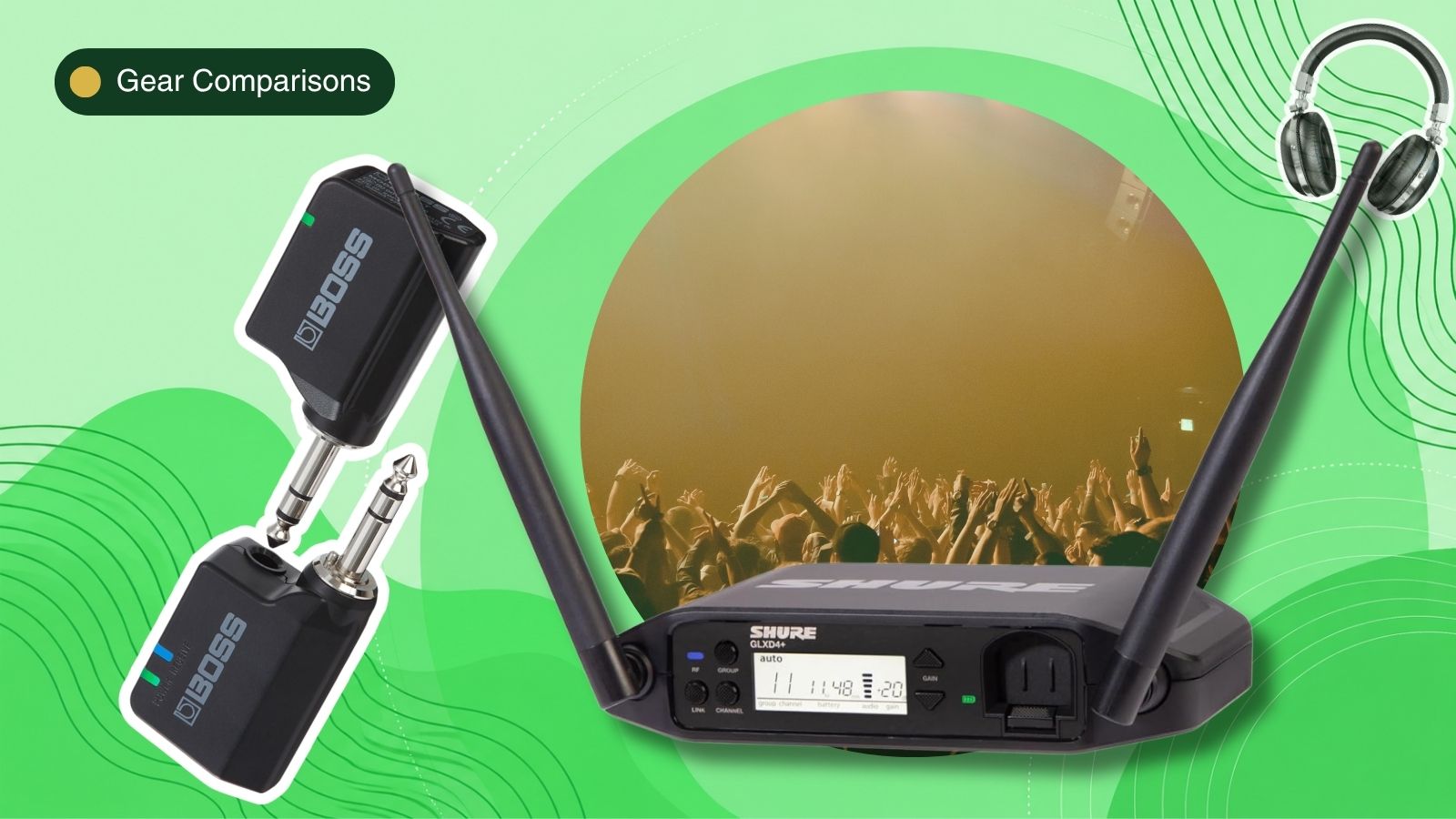
Boss WL-20
The Boss WL-20 is one of the easiest wireless guitar systems to use. You plug the transmitter into your guitar, plug the receiver into your amp or pedalboard and you are basically ready to go.
- Simple plug-and-play setup.
- Automatically sets the best channel.
- Small and light for easy transport.
- Designed to feel natural like a guitar cable.
Why Is It Great?
I think this is the best choice for players who want to get away from cables without having to think too hard about menus, channels or pairing. It automatically sets the best channel, feels small enough to throw in a gig bag and has a natural sound profile that still feels close to using a normal guitar cable.

The Pros & Cons of Boss WL-20
Pros
- Simple setup with no menus
- Natural tone like a guitar cable
- Small and light for easy transport
- Good battery life for regular playing
- Great first wireless system
Cons
- Shorter range than the more expensive options
- Not as full-featured as a pro stage system
- May not suit large stages or touring setups
Shure GLXD14
The Shure GLXD14 is a more serious wireless system for players who need solid performance and do not want to worry about the signal dropping out halfway through a set.
- Built for pro level reliability.
- Rechargeable battery can last up to 16 hours.
- Automatic frequency management.
- Strong choice for busy wireless environments.
Why Is It Great?
This is the one I would look at if reliability is the main concern. Shure has a strong reputation in live sound, and the GLXD14 is built around clarity, consistency and automatic frequency management. The battery life is also excellent, which makes it better suited to long rehearsals, long sets and stage-heavy musicians.

The Pros & Cons of Shure GLXD14
Pros
- Super battery life
- Handles interference automatically
- Premium build quality
- Good for serious stage use
Cons
- More expensive
- More than casual players may need
- Less plug-and-play than smaller systems
Sennheiser XSW-D
The Sennheiser XSW-D is a good middle ground for players who want professional sound quality but still want the system to feel simple and modern.
- Simple one-button operation.
- Clean minimalist design.
- USB recharging.
- Professional sound in a simple device.
Why Is It Great?
I like this one because it has a clean design and simple one-button operation. It does not feel overly complicated, but it still gives you proper wireless performance. The range is also very strong, which makes it a good option for players who want more freedom on stage without moving into a huge touring rig setup.

The Pros & Cons of Sennheiser XSW-D
Pros
- Minimalist design
- One-button control
- Crisp full-range sound
- Low latency
Cons
- More expensive than entry-level options
- Simple controls may not suit people who want more settings
- Small parts need to be kept safe
FAQ
Are wireless guitar systems worth it?
Yes, they can be worth it if you play live, rehearse regularly or just hate being tied to a cable. The main benefit is freedom to move around while still keeping your guitar signal clean.
Do wireless guitar systems affect tone?
Older systems could affect tone more noticeably, but modern systems are much better. A good wireless guitar system should sound very close to using a normal cable.
What latency is good for a wireless guitar system?
As a simple guide, under 5ms is a good target. The lower the latency, the closer your playing and sound will feel in real time.
Which wireless guitar system is best for beginners?
The Boss WL-20 is a strong beginner choice because it is simple, compact and easy to use. You do not need to spend much time setting it up.
Which wireless guitar system is best for live gigs?
The Shure GLXD14 is the strongest choice here for regular live gigs because it has strong battery life, good range and automatic frequency handling.
Recap & Final Thoughts On Wireless Guitar Systems
So there you have it, my guide to wireless guitar systems.
Wireless systems were first introduced in the late 70s. Back then, they were bulky and more prone to interference. Modern systems are compact, reliable and can deliver sound quality that gets very close to a normal cable.
They work by transmitting your guitar signal as a radio frequency to a receiver, then converting it back to audio. Digital systems are now common because they give players clear sound, low noise and freedom on stage.
To quickly summarise the products mentioned:
- The Boss WL-20 is probably the easiest to set up. It is perfect for players who just want to plug in and go.
- The Shure GLXD14 is for demanding players who need professional reliability, strong range and excellent battery life.
- The Sennheiser XSW-D offers professional sound in a clean, minimalist and easy-to-use package.
If you are just starting with wireless guitar systems, I would look at the Boss WL-20 first. If you are gigging regularly and reliability is the main thing, the Shure GLXD14 is the stronger choice. If you want something simple but still professional, the Sennheiser XSW-D makes a lot of sense.
As always, thanks very much for reading and let me know in the comments if you have any questions, opinions or ideas for my next article.
Have a great one!
ABOUT THE AUTHOR