 By Matt
• Gear Comparisons
• Published 25 Nov 2026
A Look At Which Acoustic Amplifier Makes Sense?
Before you start reading, just letting you know that my site contains affiliate links, at no extra cost to you, but they may give me a small commission to help run the site. Feel free to get extra info on my disclaimers page. Thanks and on with the show...
When people talk about a guitar amp, they usually mean something to give an electric guitar a particular sound. That might be a bit of distortion, a strong middle or a familiar character from the speaker.
With an acoustic guitar, you're usually in search of something else. You want the notes, finger noise and higher sounds of the strings to come through without the amp making everything sound unnatural. Acoustic amps are designed to reproduce a wider range of sound. That build is also useful for a microphone because a singing voice needs to sound like a voice.
The one potential issue is that your guitar needs a way of sending a signal to the amp. An acoustic-electric guitar has a pickup built in or fitted to it. A purely acoustic guitar with no pickup can't be connected using an ordinary guitar cable. You would need to add a pickup or use a microphone.
How One Amp Handles Both Your Guitar and Your Voice
When you plug a guitar and microphone into the same amp, you're using two channels. One carries the guitar signal and the other your voice. Each will have its own volume control meaning that if you're singing quietly you don't have to turn the guitar down to hear yourself.
Tone controls matter for the same reason. You may want to take some of the boom out of a guitar but add a little body to your vocal. With the separated controls, you can do one without changing the other.
This setup is often enough for one person performing in a smaller space. It becomes less useful when a second singer arrives or you need to send sound evenly across a bigger room. A small PA with a mixer gives you more inputs and more control over where the sound goes.
Why an Acoustic Guitar Can Feed Back at Modest Volume
Feedback is sound coming out of the speaker and returning to the guitar pickup or microphone, then getting made louder again. As it keeps looping, you hear a whistle, squeal or low rumble.
Acoustic guitars can be awkward because their bodies are designed to vibrate. That's great when you're unplugged, but a loudspeaker can get the body vibrating too.
Before turning knobs, try moving the amp so it isn't going straight at your guitar or microphone. Keep the vocal mic close enough that you don't have to turn its channel up excessively. If you're standing in front of the speaker, lowering the volume a little can do more than adding effects or other settings.
Will 40 or 60 Watts Be Enough for a Café Gig?
Honestly, forty watts and 60 watts aren't as far apart in perceived volume as the numbers make them look. The speaker, the room and how hard you turn things up matter as well. And this also matters given we are specifically focused on acoustic guitars in this post.
At home, you'll usually not need to be anywhere near the amp's max output. At a café with people talking over their coffee, you may need more level but you also want the words in the song to be clear. In a noisy bar, an acoustic amp might need to be louder to get over the people drinking and talking.
Four Things You Might Not Know About Acoustic Amps
A Speaker Can Have an Extra Cone
Fender uses something called a whizzer cone in its Acoustasonic 40 speakers. It's a smaller cone attached to the main speaker to help reproduce higher notes.
Sixty Watts Can Be Split Between Speakers
The BOSS Acoustic Singer Live LT has a 60-watt rating, but that power is divided between two amplifiers: 50 watts for the larger speaker and 10 watts for the high-frequency speaker.
Two Channels Don't Mean Stereo
On these acoustic amps, two channels means you can plug in two sound sources, such as a guitar and a microphone. It doesn't mean your guitar goes through a left speaker while your voice goes through a right one.
A Microphone Cable Can Carry Power
Some microphones need electricity to work, and certain sound systems send that power through the same XLR cable that carries the sound. It's called phantom power. Most common dynamic vocal microphones don't need it, but many condenser microphones do.
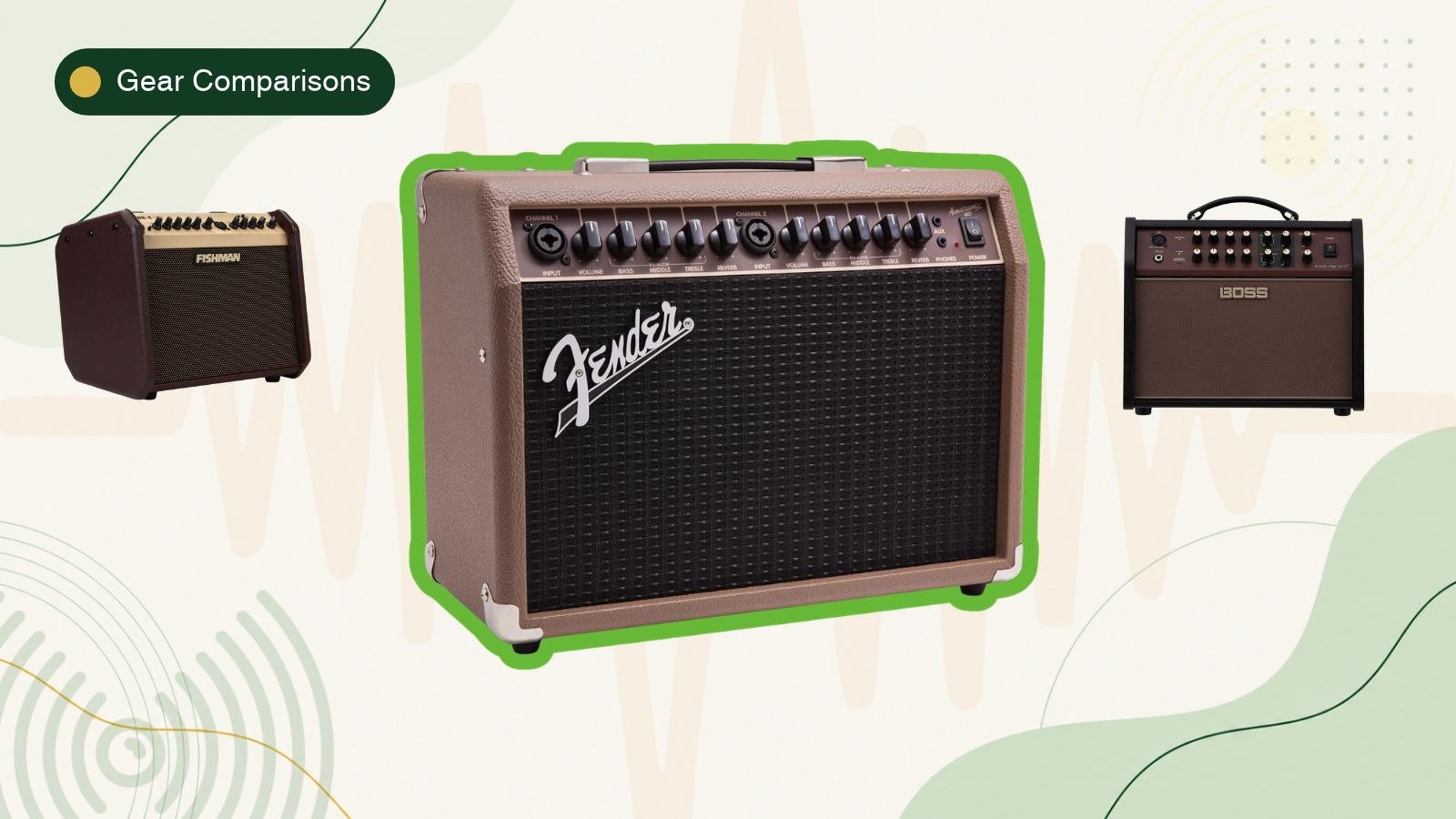
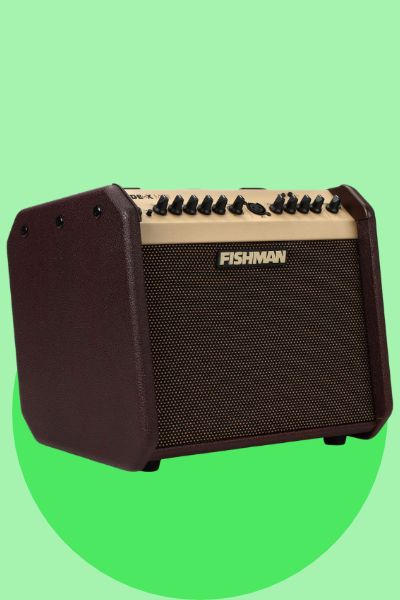
Fishman Loudbox Mini BT
A 60-watt acoustic amp with separate guitar and microphone channels + Bluetooth for playing accompanying music from your phone or tablet.
- 60-watt output
- Guitar and mic channels
- Bluetooth audio
- Reverb and chorus
Why Is It Great?
You can set the guitar and vocal levels separately, with reverb on both channels and chorus if you want to change the guitar sound a bit. Bluetooth is used for backing tracks without needing another cable. There's also a phase switch that may help with feedback.
The Pros & Cons of Fishman Loudbox Mini BT
Pros
- Separate guitar and mic
- Bluetooth music playback
- Reverb on both channels
- Chorus for guitar
- XLR output for a PA
Cons
- No battery operation
- No USB recording
- No mic midrange control
- Only two main channels
- XLR-only microphone jack
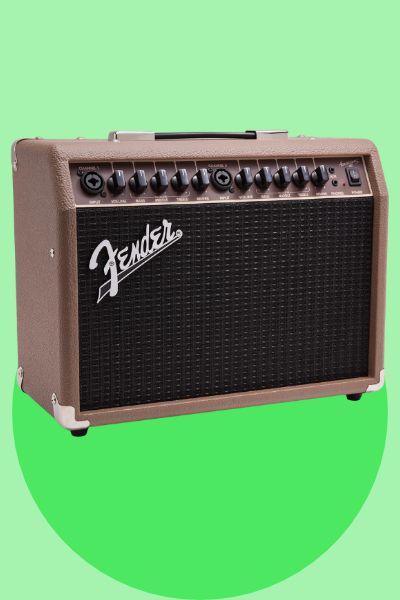
Fender Acoustasonic 40
A 40-watt acoustic amp with two inputs that can both take a guitar or microphone cable + separate tone and reverb controls.
- 40-watt output
- Two combo XLR inputs
- Reverb per channel
- Headphone socket
Why Is It Great?
Both channels accept a guitar cable or an XLR microphone cable, so you can dont have to worry which socket is for which instrument. You get bass, middle and treble controls on each channel + reverb. For a guitar and one vocal mic, that's a lot of what you need.
The Pros & Cons of Fender Acoustasonic 40
Pros
- Two flexible inputs
- 3-band EQ on both
- Reverb on both channels
- Headphone output
- XLR output for a PA
Cons
- No Bluetooth audio
- No chorus effect
- No built-in notch filter
- Lower output rating
- No USB recording
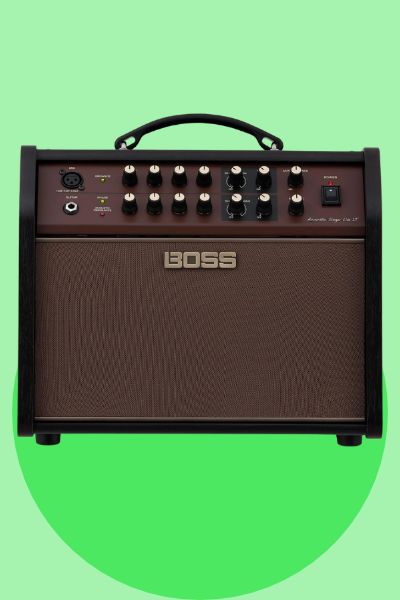
BOSS Acoustic Singer Live LT
A 60-watt acoustic amp for guitar and vocals that has extra feedback controls, a separate channel effects and USB connection for recording.
- 60-watt bi-amp
- EQ on both channels
- Anti-feedback control
- USB audio connection
Why Is It Great?
If your guitar pickup sounds a bit harsh, there is an Acoustic Resonance setting that gives you another way to shape it. The anti-feedback knob helps when a room starts making notes ring or boom. There's also a USB connection for recording into a computer + separate effects for guitar and voice.
The Pros & Cons of BOSS Acoustic Singer Live LT
Pros
- 3-band EQ on both
- Feedback notch control
- USB computer recording
- Optional footswitches
Cons
- No Bluetooth playback
- No built-in looper
- No vocal harmonies
- No phantom mic power
- Footswitches cost extra
FAQ
Can I plug a normal acoustic guitar into an amplifier?
Only if it has a pickup fitted. Many acoustic-electric guitars have one built in and connect with a normal guitar cable. If your guitar has no pickup, you'll need a suitable pickup or a microphone to get its sound into an amplifier.
Can I sing and play guitar through the same amp?
Yes, if the amp has separate inputs for your guitar and microphone. All three models in the post have two channels, so you can set the balance between singing and playing without a mixer.
Is a 40-watt acoustic amp loud enough for a small gig?
I would say that it probably will be, especially for a café or a small indoor performance. The room, crowd noise and where you put the amp matter though. If you play in really noisy venues, it may be better to connect to a PA rather than rely on the amp alone.
Does Bluetooth mean I can connect my guitar without a cable?
Not in this case. On an amp like the Fishman Loudbox Mini BT in this article, Bluetooth is for playing music or backing tracks from another device.
Do I need a PA system as well as an acoustic amp?
Not all the time but, some instances could call for it. For one singer and one guitar in a small room, a two-channel acoustic amp will be enough in most cases. A PA becomes needed when you have extra microphones, wider sound coverage or more volume. The three amps here can feed into a PA through an XLR output.
So, Which Acoustic Amplifier Would I Choose?
There's no single right answer. It depends on where you'll use it most and how much control you actually want when you're playing.
The Fender Acoustasonic 40 makes the most sense if you're starting out or playing in smaller rooms. Two flexible inputs, separate tone controls and reverb meet the needs without learning a bunch of extra settings.
The Fishman Loudbox Mini BT sits in the middle. It gives you a bigger 60 watts, separate guitar and vocal channels and Bluetooth playback. Thats great if your show uses backing tracks.
The BOSS Acoustic Singer Live LT is the one I'd consider if you need to deal with awkward rooms or want to connect the amp to a computer. Its feedback control and separate effects are pretty great in those situations.
ABOUT THE AUTHOR